#Devops Day13
Hello, Everyone, This is my 13 blog started my day13 as AWS DevOps Engineer #90daysofchallenge with ShubhamLondhe #devops #trainwithshubham.
PYTHON:-
Python is a Open source, interpreted, general purpose, high level, and object-oriented programming language.
Guido Van Rossum Created the Python Programming language in feb 1991.
Python allows us to create a game, built web apps, do general purpose Scripting etc.
Programming helps human beings to reduce hours of manual efforts.
Python is used by many of the best tech Companies.
E.g. Insta, Facebook, Google, Reddit, Spotify etc.
It is Dynamically typed.
Python consists of vast libraries and various frameworks like Django, Tensorflow, Flask, Pandas, Keras etc.
In Python there are two types of modules.
Built In :- Built in modules are pre- installed in python. There is no need to download them.
->It come with the python interpreter itself.
-> E.g. Random, OS etc.
External Module -: There are the modules that are not pre installed in python. i.e. we need to download before using them in our program.
For e.g. Flask, Pandas, Tenserflow etc.
Task1:
Install Python in your respective OS, and check the version.
Ans:- How to install python.
For Ubuntu:
->Let's update our server with latest packages first,
Sudo apt update
->Now let's install python version-3.6 with following command
Sudo apt install python
->To check version of python
python3 --version
For windows:
You should follow the link: Download Python | Python.org
Read about different Data Types in Python.
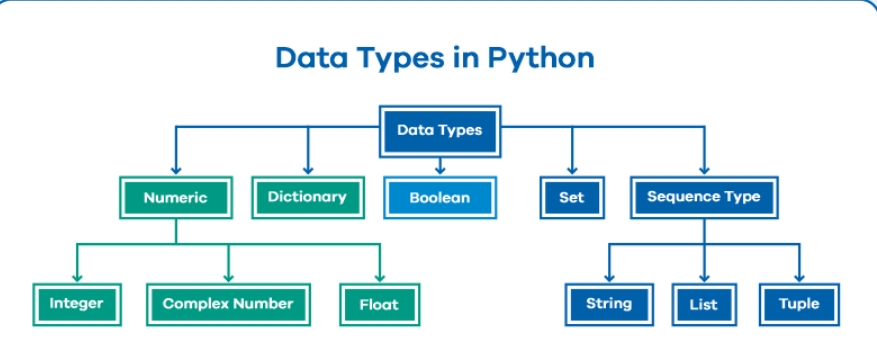
Ans:- Data types in Python:-
->Data Type in Python is used to classify the value stored in a variable during the program execution.
-> Whenever a variable is defined in Python, the interpreter allocates some memory according to the data stored in the variable
->Data types specifies the types of a variable holds.
-> By default , python provides built in data types.
Types :-
Numeric data:-
-> Int :- it is used to store the integer values
- Integer (<class 'int'>)
-> Floating point number:- Used to store decimal or floating point number
- (<class 'float'>)
->Complex (complex): Complex numbers are used to represent numbers with a real and imaginary part. They are written in the form of a + bj, where a is the real part and b is the imaginary part.
Boolean Data Types:-
Boolean Data Type(bool): Represents either True or False, used for logical operations and conditions.
- (<class 'bool'>)
Sequenced Data types:-
-> String Data Type(str): Represents a sequence of characters enclosed in single quotes (‘ ‘) or double quotes (” “), such as “Hello, World!”, ‘Python’.
- (<class 'str'>)
-> List:- List are used to store multiple item in a single variable.
- List are mutable .
->Tuples:- Tuples is an ordered collection of data with element separated by comma and enclosed with in parenthesis.
- Tuples are immutable and cannot be modified after creation.